
Datasets:

image imagewidth (px) 4.03k 4.03k | label class label 3
classes |
|---|---|
0A1 | |
0A1 | |
1A2 | |
1A2 | |
2A3 | |
2A3 | |
0A1 | |
0A1 | |
1A2 | |
1A2 | |
2A3 | |
2A3 | |
0A1 | |
0A1 | |
1A2 | |
1A2 | |
2A3 | |
2A3 | |
0A1 | |
0A1 | |
1A2 | |
1A2 | |
2A3 | |
2A3 | |
0A1 | |
0A1 | |
1A2 | |
1A2 | |
2A3 | |
2A3 | |
0A1 | |
0A1 | |
1A2 | |
1A2 | |
2A3 | |
2A3 | |
0A1 | |
0A1 | |
1A2 | |
1A2 | |
2A3 | |
2A3 | |
0A1 | |
0A1 | |
1A2 | |
1A2 | |
2A3 | |
2A3 | |
0A1 | |
0A1 | |
1A2 | |
1A2 | |
2A3 | |
2A3 | |
0A1 | |
0A1 | |
1A2 | |
1A2 | |
2A3 | |
2A3 | |
0A1 | |
0A1 | |
1A2 | |
1A2 | |
2A3 | |
2A3 | |
0A1 | |
0A1 | |
1A2 | |
1A2 | |
2A3 | |
2A3 | |
0A1 | |
0A1 | |
1A2 | |
1A2 | |
2A3 | |
2A3 | |
0A1 | |
0A1 | |
1A2 | |
1A2 | |
2A3 | |
2A3 | |
0A1 | |
0A1 | |
1A2 | |
1A2 | |
2A3 | |
2A3 | |
0A1 | |
0A1 | |
1A2 | |
1A2 | |
2A3 | |
2A3 |
Turkish passport dataset - 5, 000 images
Dataset comprises 5,000 meticulously organized files capturing Turkish passports under highly controlled variations, making it an invaluable resource for developing robust document recognition and verification systems. It is specifically designed for training and testing models in passport authentication, biometric data extraction, and identity verification.
By leveraging this dataset containing detailed information from Turkish passports, developers and government officials can enhance systems for identifying Turkish citizens, classifying travel documents. - Get the data
💵 Buy the Dataset: This is a limited preview of the data. To access the full dataset, please contact us at https://unidata.pro to discuss your requirements and pricing options.
Each set of 96 files systematically varies key parameters including 3 angles (0°, 25°, 45°), 4 lighting conditions (Natural-daylight, Office-LED, Warm-indoor, Dim-light), 4 backgrounds (Neutral wall, Textured desk, Outdoor pavement, Docs-on-docs), and 2 distances (Close, Medium) to simulate real-world scenarios.
Example of the data
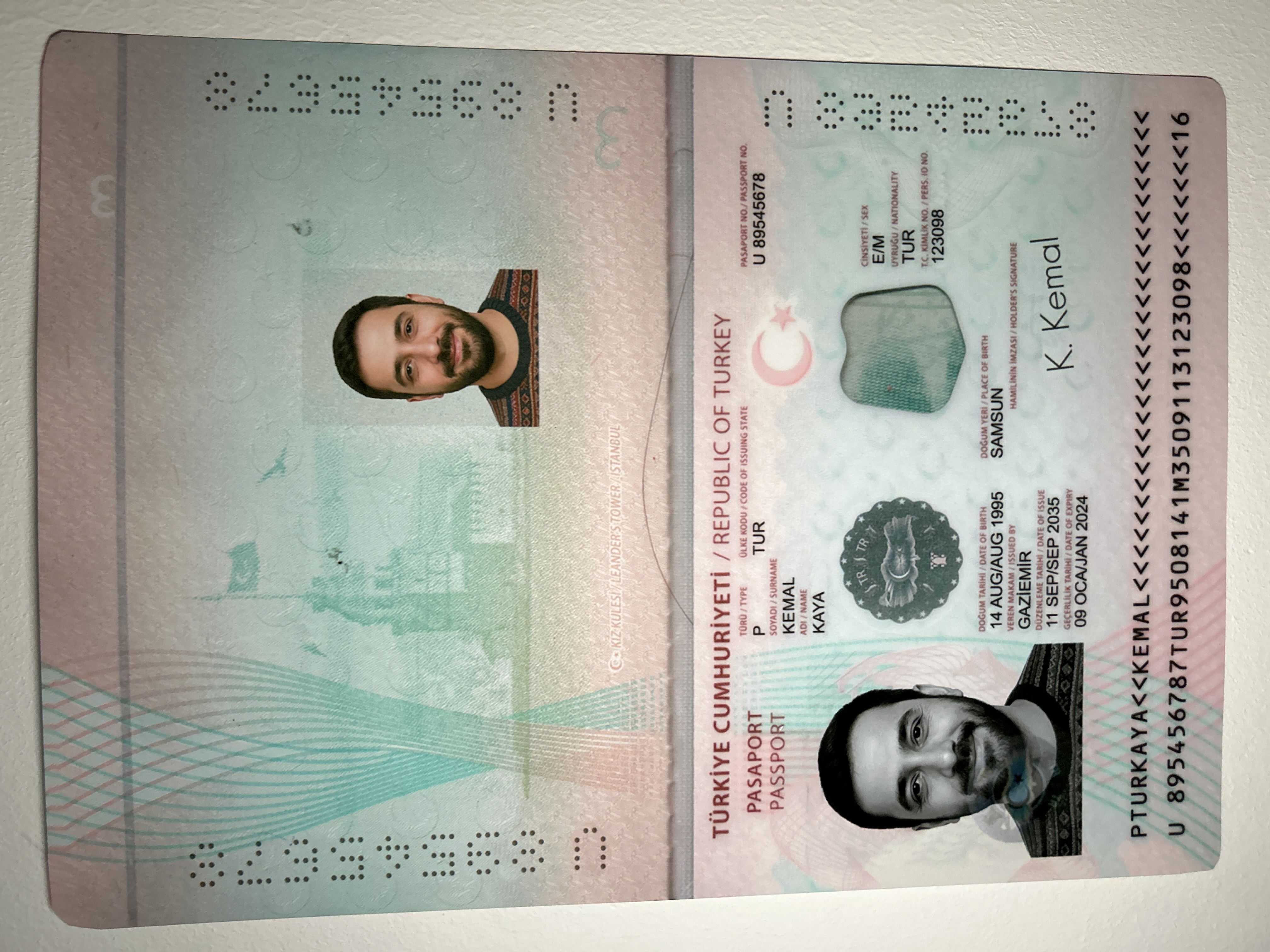
The dataset provides government officials and researchers with comprehensive data for developing advanced systems to process passports held by Turkish citizens, ensuring secure border control and reliable identity verification while maintaining the privacy of personal information.
Frequently Asked Questions
Why are synthetic passports valuable for identity verification research?
Synthetic identity documents eliminate the privacy risks associated with using real personal information while still providing realistic document layouts and visual characteristics.
How can the metadata be used during model development?
Beyond OCR targets, the metadata enables controlled experiments that isolate factors affecting model performance. Researchers can compare recognition accuracy across different lighting conditions, camera angles, capture distances, and demographic attributes to identify failure cases.
🌐 UniData provides high-quality datasets, content moderation, data collection and annotation for your AI/ML projects
- Downloads last month
- 23