| --- |
| datasets: |
| - BatsResearch/ctga-v1 |
| language: |
| - en |
| library_name: transformers |
| pipeline_tag: text2text-generation |
| tags: |
| - data generation |
| license: apache-2.0 |
| --- |
| |
| # Model Card for bonito |
|
|
| <!-- Provide a quick summary of what the model is/does. --> |
|
|
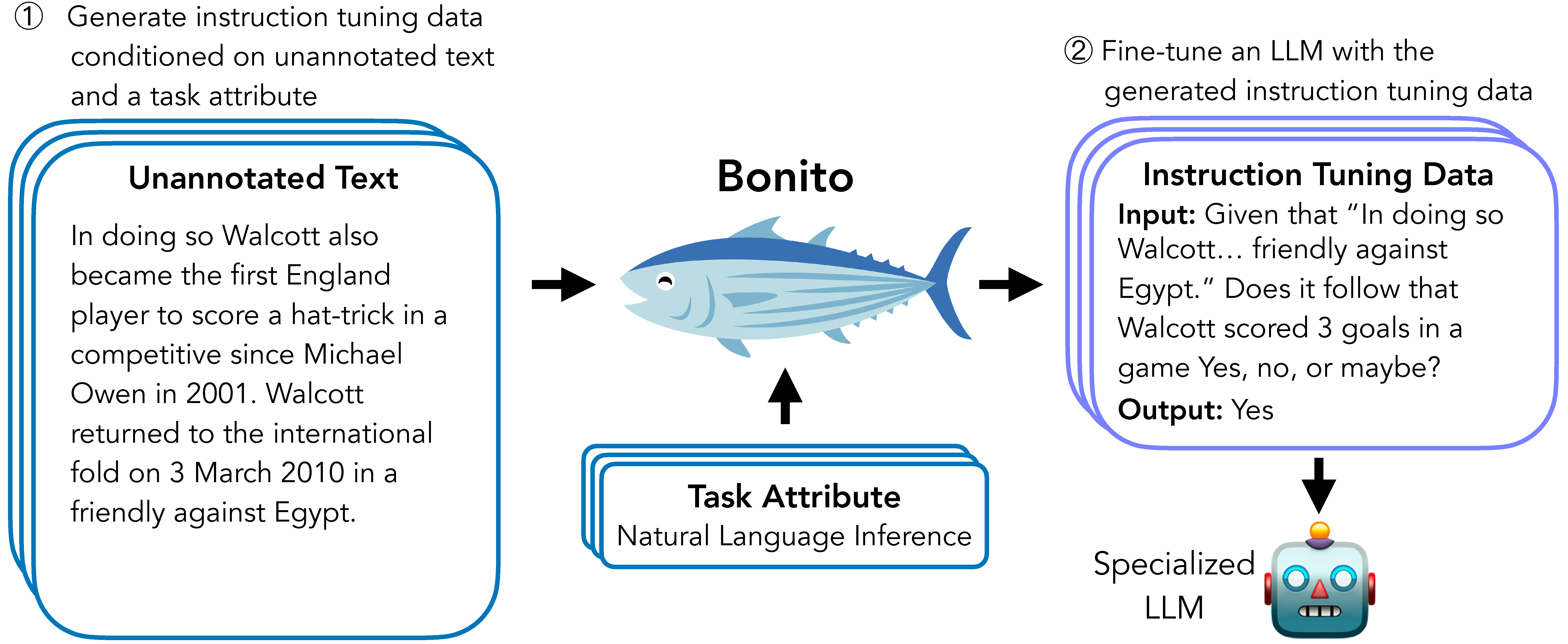
| Bonito is an open-source model for conditional task generation: the task of converting unannotated text into task-specific training datasets for instruction tuning. |
|
|
|  |
|
|
| ## Model Details |
|
|
| ### Model Description |
|
|
| <!-- Provide a longer summary of what this model is. --> |
|
|
| Bonito can be used to create synthetic instruction tuning datasets to adapt large language models on users' specialized, private data. |
| In our [paper](https://arxiv.org/abs/2402.18334), we show that Bonito can be used to adapt both pretrained and instruction tuned models to tasks without any annotations. |
|
|
| - **Developed by:** Nihal V. Nayak, Yiyang Nan, Avi Trost, and Stephen H. Bach |
| - **Model type:** MistralForCausalLM |
| - **Language(s) (NLP):** English |
| - **License:** Apache 2.0 |
| - **Finetuned from model:** `mistralai/Mistral-7B-v0.1` |
|
|
| ### Model Sources |
|
|
| <!-- Provide the basic links for the model. --> |
|
|
| - **Repository:** [https://github.com/BatsResearch/bonito](https://github.com/BatsResearch/bonito) |
| - **Paper:** [Learning to Generate Instruction Tuning Datasets for |
| Zero-Shot Task Adaptation](https://arxiv.org/abs/2402.18334) |
|
|
| ## Uses |
|
|
| <!-- Address questions around how the model is intended to be used, including the foreseeable users of the model and those affected by the model. --> |
|
|
| ### Direct Use |
|
|
| <!-- This section is for the model use without fine-tuning or plugging into a larger ecosystem/app. --> |
| To easily generate synthetic instruction tuning datasets, we recommend using the [bonito](https://github.com/BatsResearch/bonito) package built using the `transformers` and the `vllm` libraries. |
|
|
| ```python |
| from bonito import Bonito |
| from vllm import SamplingParams |
| from datasets import load_dataset |
| |
| # Initialize the Bonito model |
| bonito = Bonito("BatsResearch/bonito-v1") |
| |
| # load dataaset with unannotated text |
| unannotated_text = load_dataset( |
| "BatsResearch/bonito-experiment", |
| "unannotated_contract_nli" |
| )["train"].select(range(10)) |
| |
| # Generate synthetic instruction tuning dataset |
| sampling_params = SamplingParams(max_tokens=256, top_p=0.95, temperature=0.5, n=1) |
| synthetic_dataset = bonito.generate_tasks( |
| unannotated_text, |
| context_col="input", |
| task_type="nli", |
| sampling_params=sampling_params |
| ) |
| ``` |
|
|
|
|
| ### Out-of-Scope Use |
|
|
| <!-- This section addresses misuse, malicious use, and uses that the model will not work well for. --> |
|
|
| Our model is trained to generate the following task types: summarization, sentiment analysis, multiple-choice question answering, extractive question answering, topic classification, natural language inference, question generation, text generation, question answering without choices, paraphrase identification, sentence completion, yes-no question answering, word sense disambiguation, paraphrase generation, textual entailment, and |
| coreference resolution. |
| The model might not produce accurate synthetic tasks beyond these task types. |
|
|
| ## Bias, Risks, and Limitations |
|
|
| <!-- This section is meant to convey both technical and sociotechnical limitations. --> |
| **Limitations** |
|
|
| Our work relies on the availability of large amounts of unannotated text. |
| If only a small quantity of unannotated text is present, the target language model, after adaptation, may experience a drop in performance. |
| While we demonstrate positive improvements on pretrained and instruction-tuned models, our observations are limited to the three task types (yes-no question answering, extractive question answering, and natural language inference) considered in our paper. |
|
|
| **Risks** |
|
|
| Bonito poses risks similar to those of any large language model. |
| For example, our model could be used to generate factually incorrect datasets in specialized domains. |
| Our model can exhibit the biases and stereotypes of the base model, Mistral-7B, even after extensive supervised fine-tuning. |
| Finally, our model does not include safety training and can potentially generate harmful content. |
|
|
| ### Recommendations |
|
|
| <!-- This section is meant to convey recommendations with respect to the bias, risk, and technical limitations. --> |
|
|
| We recommend users thoroughly inspect the generated tasks and benchmark performance on critical datasets before deploying the models trained with the synthetic tasks into the real world. |
|
|
| ## Training Details |
|
|
| ### Training Data |
|
|
| <!-- This should link to a Dataset Card, perhaps with a short stub of information on what the training data is all about as well as documentation related to data pre-processing or additional filtering. --> |
| To train Bonito, we create a new dataset called conditional task generation with attributes by remixing existing instruction tuning datasets. |
| See [ctga-v1](https://huggingface.co/datasets/BatsResearch/ctga-v1) for more details. |
|
|
| ### Training Procedure |
|
|
| <!-- This relates heavily to the Technical Specifications. Content here should link to that section when it is relevant to the training procedure. --> |
|
|
| #### Training Hyperparameters |
|
|
| - **Training regime:** <!--fp32, fp16 mixed precision, bf16 mixed precision, bf16 non-mixed precision, fp16 non-mixed precision, fp8 mixed precision --> |
| We train the model using [Q-LoRA](https://github.com/artidoro/qlora) by optimizing the cross entropy loss over the output tokens. |
| The model is trained for 100,000 steps. |
| The training takes about 4 days on four GPUs to complete. |
|
|
| We use the following hyperparameters: |
| - Q-LoRA rank (r): 64 |
| - Q-LoRA scaling factor (alpha): 4 |
| - Q-LoRA dropout: 0 |
| - Optimizer: Paged AdamW |
| - Learning rate scheduler: linear |
| - Max. learning rate: 1e-04 |
| - Min. learning rate: 0 |
| - Weight decay: 0 |
| - Dropout: 0 |
| - Max. gradient norm: 0.3 |
| - Effective batch size: 16 |
| - Max. input length: 2,048 |
| - Max. output length: 2,048 |
| - Num. steps: 100,000 |
|
|
| ## Citation |
|
|
| <!-- If there is a paper or blog post introducing the model, the APA and Bibtex information for that should go in this section. --> |
| ``` |
| @inproceedings{bonito:aclfindings24, |
| title = {Learning to Generate Instruction Tuning Datasets for Zero-Shot Task Adaptation}, |
| author = {Nayak, Nihal V. and Nan, Yiyang and Trost, Avi and Bach, Stephen H.}, |
| booktitle = {Findings of the Association for Computational Linguistics: ACL 2024}, |
| year = {2024}} |
| ``` |


