new

Get trending papers in your email inbox!

Subscribe

Trending Papers

byAK and the research community

Trending Papers
Submitted by
taesiri

SkillOpt: Executive Strategy for Self-Evolving Agent Skills

SkillOpt introduces a systematic text-space optimizer for agent skills that trains skills as external agent state with stable updates and zero deployment inference overhead, achieving superior performance across multiple benchmarks and execution environments.

MicrosoftResearch Microsoft Research · May 22, 2026

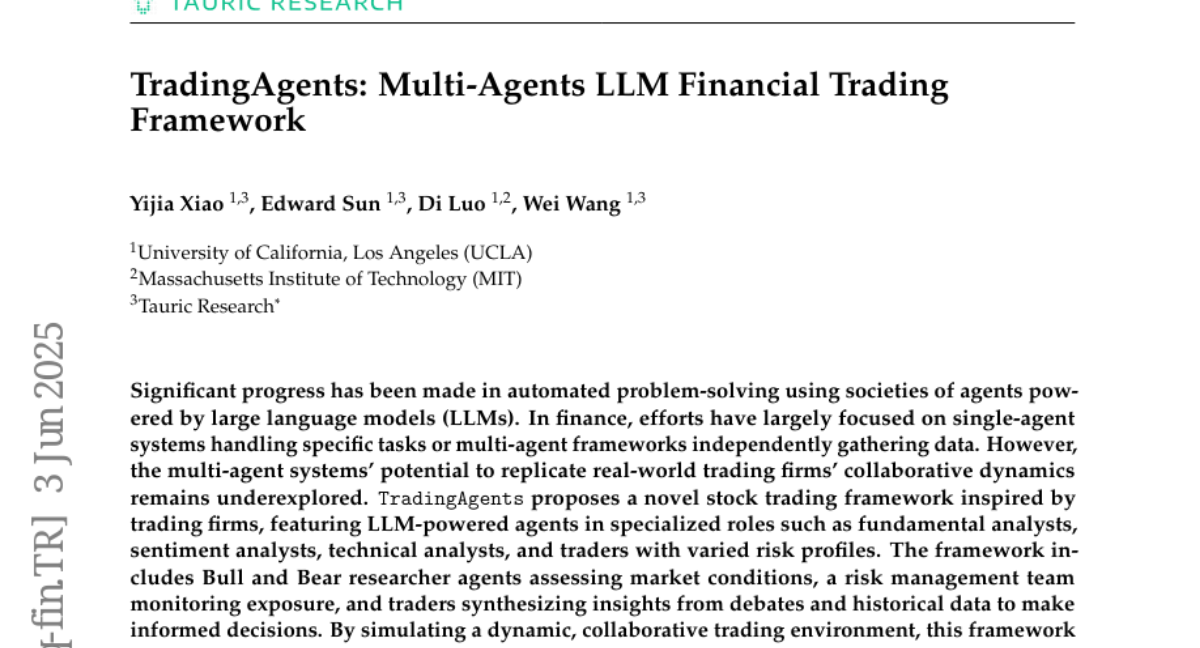
TradingAgents: Multi-Agents LLM Financial Trading Framework

A multi-agent framework using large language models for stock trading simulates real-world trading firms, improving performance metrics like cumulative returns and Sharpe ratio.

  • 4 authors
· Dec 28, 2024

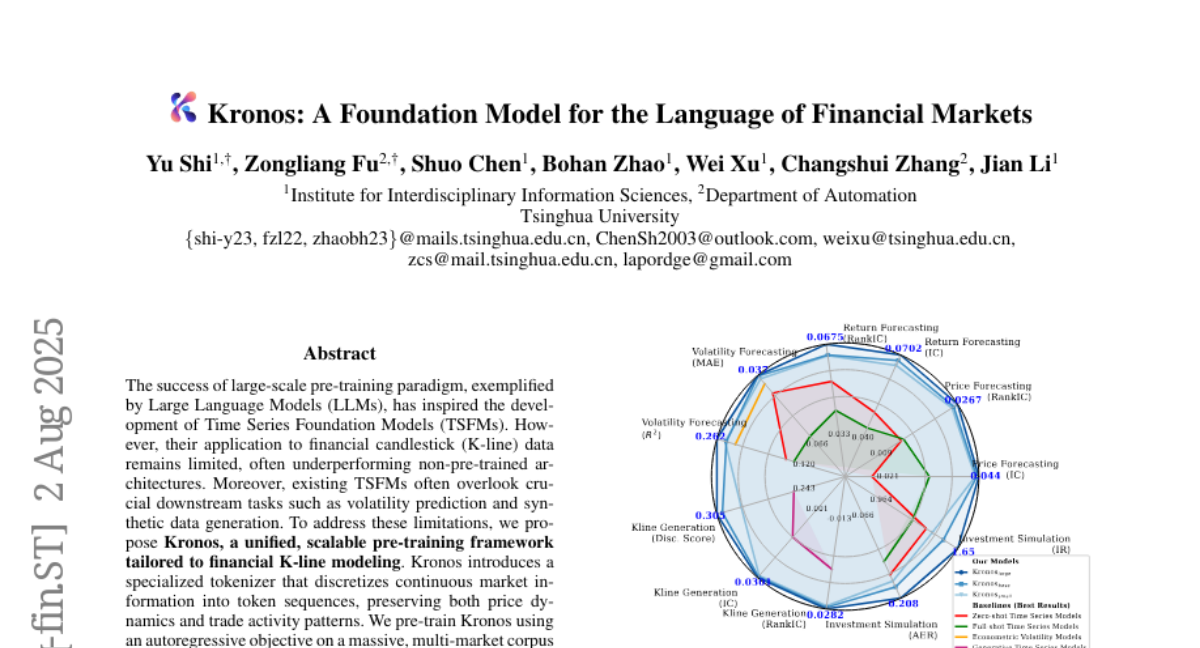
Kronos: A Foundation Model for the Language of Financial Markets

Kronos, a specialized pre-training framework for financial K-line data, outperforms existing models in forecasting and synthetic data generation through a unique tokenizer and autoregressive pre-training on a large dataset.

  • 7 authors
· Aug 2, 2025
Submitted by
taesiri

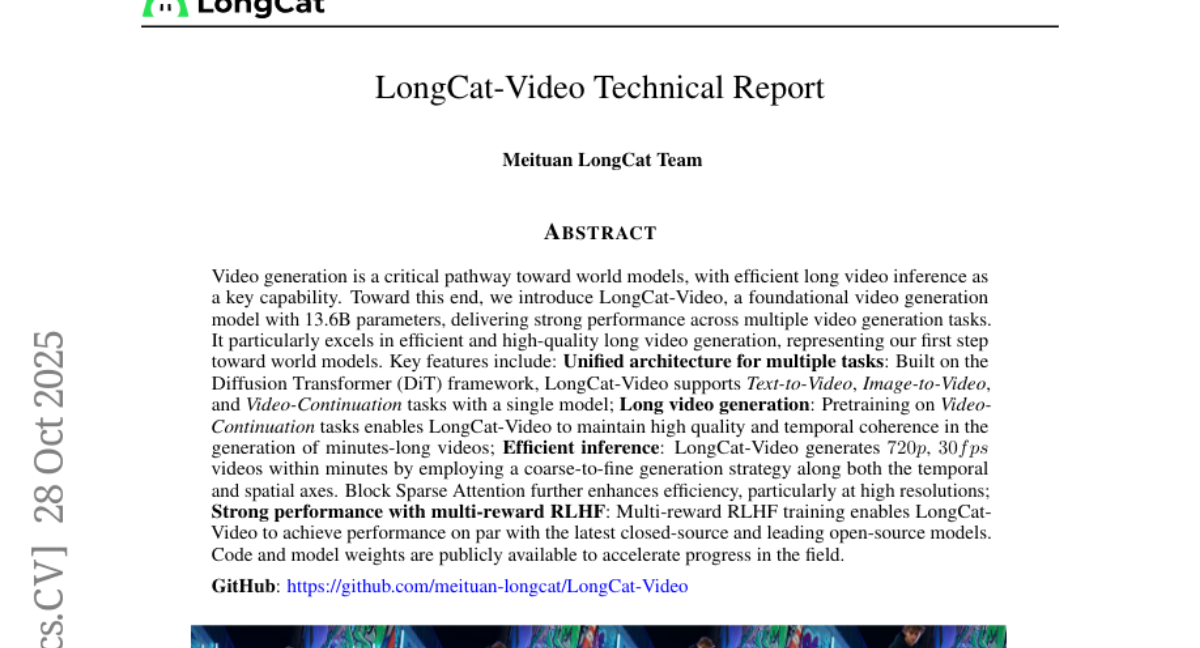
LongCat-Video Technical Report

LongCat-Video, a 13.6B parameter video generation model based on the Diffusion Transformer framework, excels in efficient and high-quality long video generation across multiple tasks using unified architecture, coarse-to-fine generation, and block sparse attention.

meituan-longcat LongCat · Oct 25, 2025

EverMemOS: A Self-Organizing Memory Operating System for Structured Long-Horizon Reasoning

EverMemOS presents a self-organizing memory system for large language models that processes dialogue streams into structured memory cells and scenes to enhance long-term interaction capabilities.
  • 11 authors
· Jan 5, 2026
Submitted by
taesiri

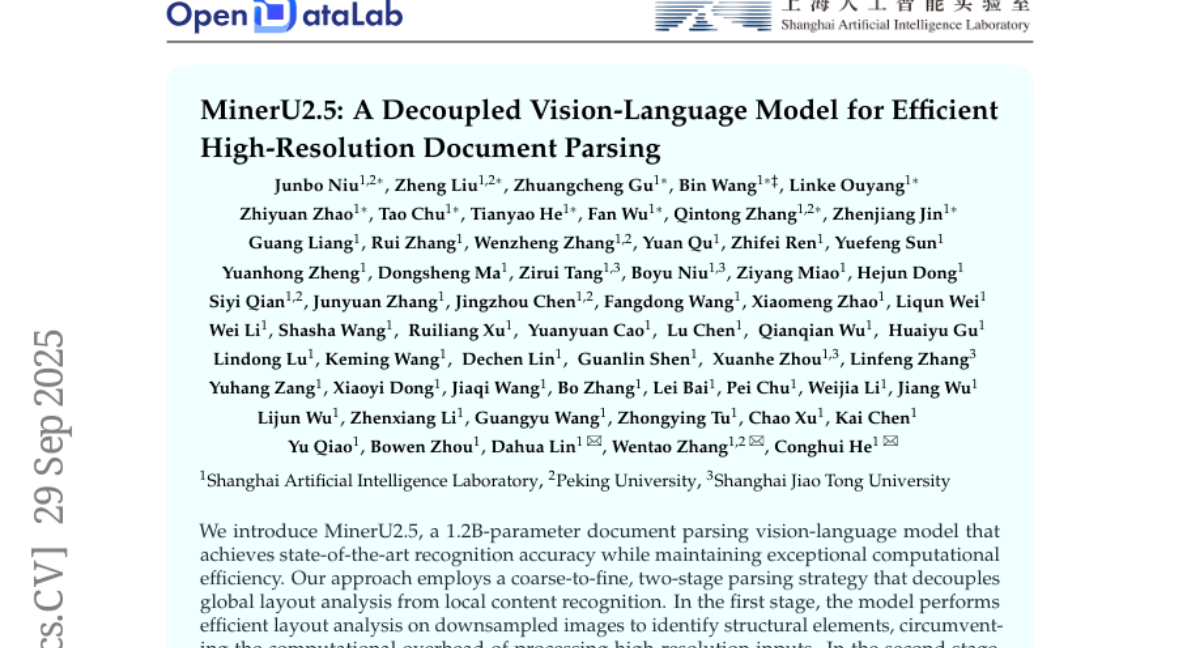
MinerU2.5: A Decoupled Vision-Language Model for Efficient High-Resolution Document Parsing

MinerU2.5, a 1.2B-parameter document parsing vision-language model, achieves state-of-the-art recognition accuracy with computational efficiency through a coarse-to-fine parsing strategy.

  • 61 authors
· Sep 26, 2025
Submitted by
zcai

VLM3: Vision Language Models Are Native 3D Learners

Vision Language Models can be adapted for 3D understanding tasks through simple architectural modifications and text-based training, achieving performance comparable to specialized vision models without requiring complex designs or extensive data augmentation.

facebook-research AI at Meta · May 28, 2026

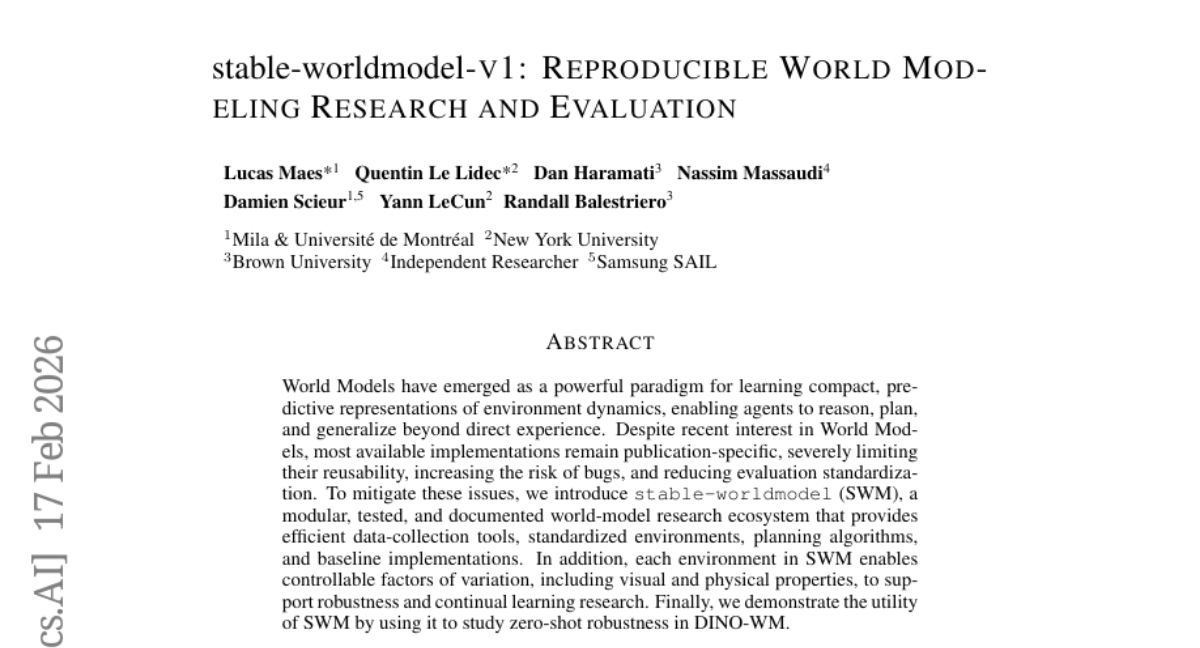
stable-worldmodel-v1: Reproducible World Modeling Research and Evaluation

Stable-worldmodel provides a modular and standardized research framework for developing and evaluating world models with controllable environmental factors for robustness and continual learning applications.

galilai-group galilai-group · Feb 9, 2026
Submitted by
fdugyt

MOSS-TTS Technical Report

MOSS-TTS is a speech generation model using discrete audio tokens and autoregressive modeling with capabilities for voice cloning, pronunciation control, and long-form generation across multiple languages.

OpenMOSS-Team OpenMOSS · Mar 18, 2026
Submitted by
taesiri

minWM: A Full-Stack Open-Source Framework for Real-Time Interactive Video World Models

A comprehensive framework is presented for converting bidirectional video diffusion models into real-time interactive world models with controllable, causal, and low-latency capabilities through fine-tuning and distillation techniques.

  • 12 authors
· May 28, 2026
Submitted by
akhaliq

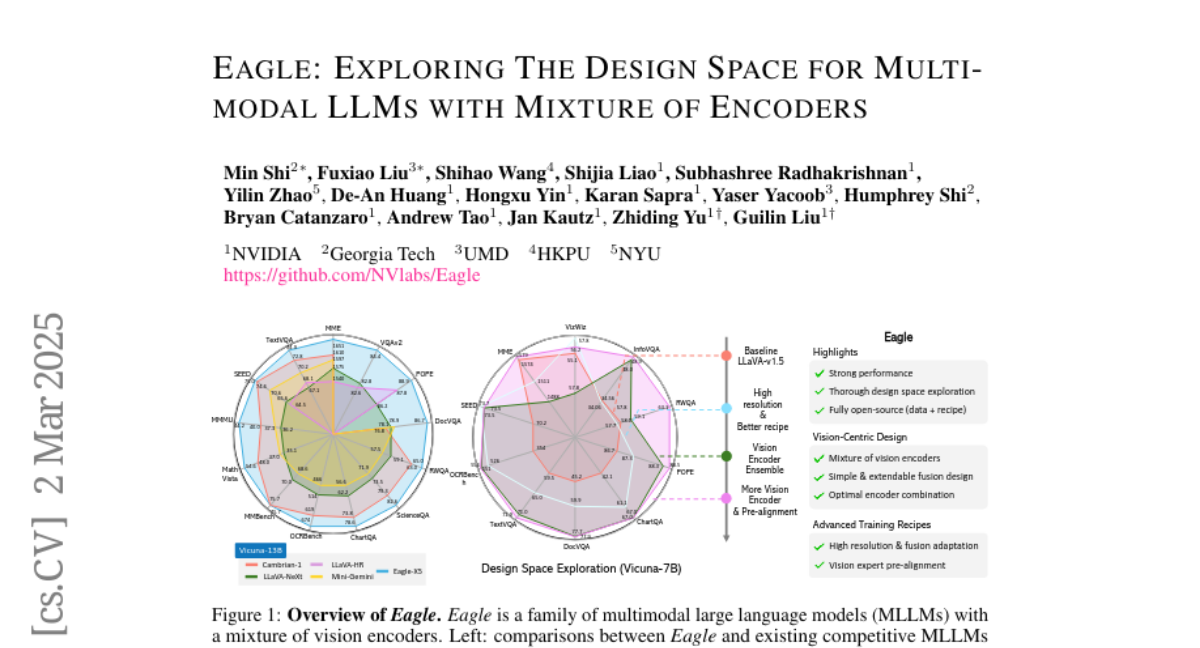
Eagle: Exploring The Design Space for Multimodal LLMs with Mixture of Encoders

Mixture of vision encoders and resolutions in multimodal large language models improves performance through concatenation of visual tokens and a Pre-Alignment mechanism, leading to superior results on benchmarks.

  • 15 authors
· Aug 28, 2024
Submitted by
akhaliq

OpenDevin: An Open Platform for AI Software Developers as Generalist Agents

OpenDevin is a platform for developing AI agents that interact with the world by writing code, using command lines, and browsing the web, with support for multiple agents and evaluation benchmarks.

  • 24 authors
· Jul 23, 2024
Submitted by
Luckyyy

VibeSearchBench: Benchmarking Long-horizon Proactive Search in the Wild

LLM-based agents perform poorly on VibeSearch benchmark, which evaluates multi-turn dialogue search scenarios reflecting real user-agent collaboration rather than traditional single-turn query tasks.

rednote-hilab rednote-hilab · May 27, 2026
Submitted by
taesiri

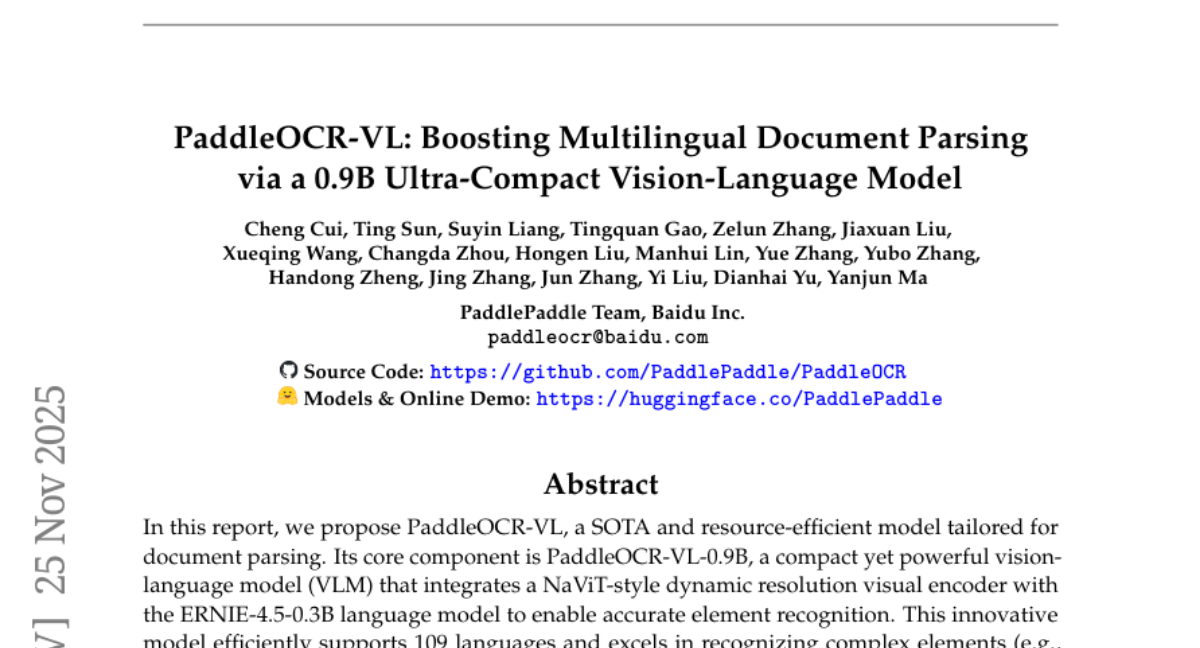
PaddleOCR-VL: Boosting Multilingual Document Parsing via a 0.9B Ultra-Compact Vision-Language Model

PaddleOCR-VL, a vision-language model combining NaViT-style dynamic resolution and ERNIE, achieves state-of-the-art performance in document parsing and element recognition with high efficiency.

PaddlePaddle PaddlePaddle · Oct 16, 2025
Submitted by
akhaliq

Mem0: Building Production-Ready AI Agents with Scalable Long-Term Memory

Mem0, a memory-centric architecture with graph-based memory, enhances long-term conversational coherence in LLMs by efficiently extracting, consolidating, and retrieving information, outperforming existing memory systems in terms of accuracy and computational efficiency.

  • 5 authors
· Apr 28, 2025
Submitted by
akhaliq

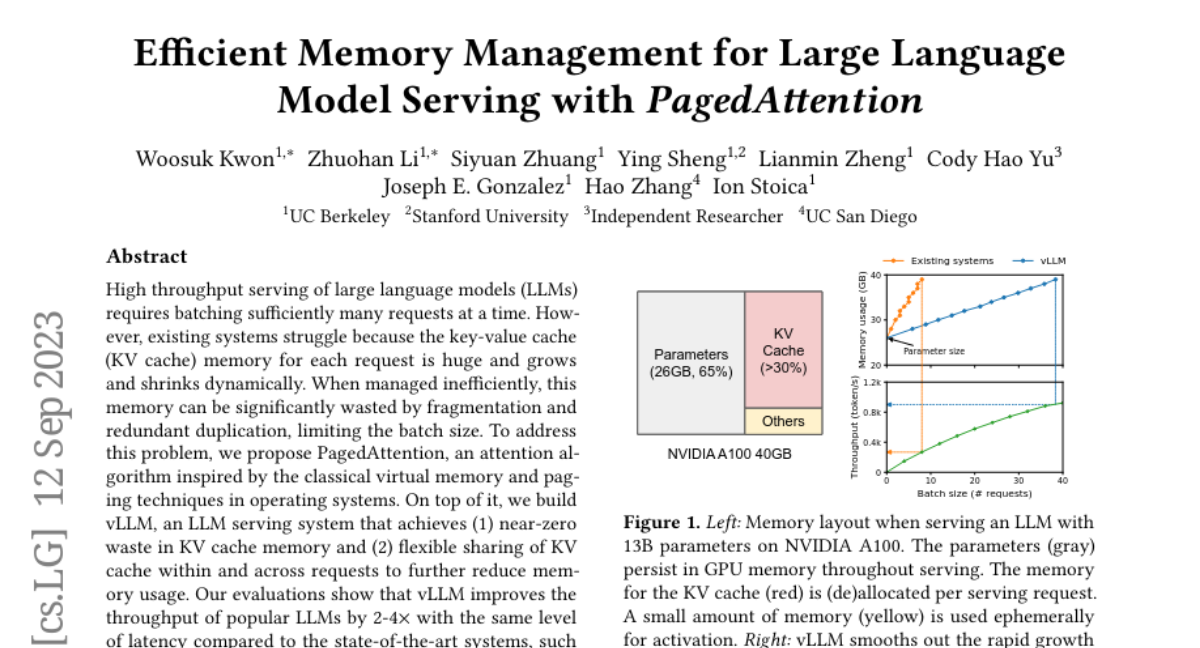
Efficient Memory Management for Large Language Model Serving with PagedAttention

PagedAttention algorithm and vLLM system enhance the throughput of large language models by efficiently managing memory and reducing waste in the key-value cache.

  • 9 authors
· Sep 12, 2023
Submitted by
jasonrqh

COLLEAGUE.SKILL: Automated AI Skill Generation via Expert Knowledge Distillation

Person-grounded AI skills are automatically distilled from heterogeneous traces into inspectable, correctable packages that capture both capabilities and behavioral patterns.

ShanghaiAiLab shanghai ailab · May 29, 2026
Submitted by
RuofengYang

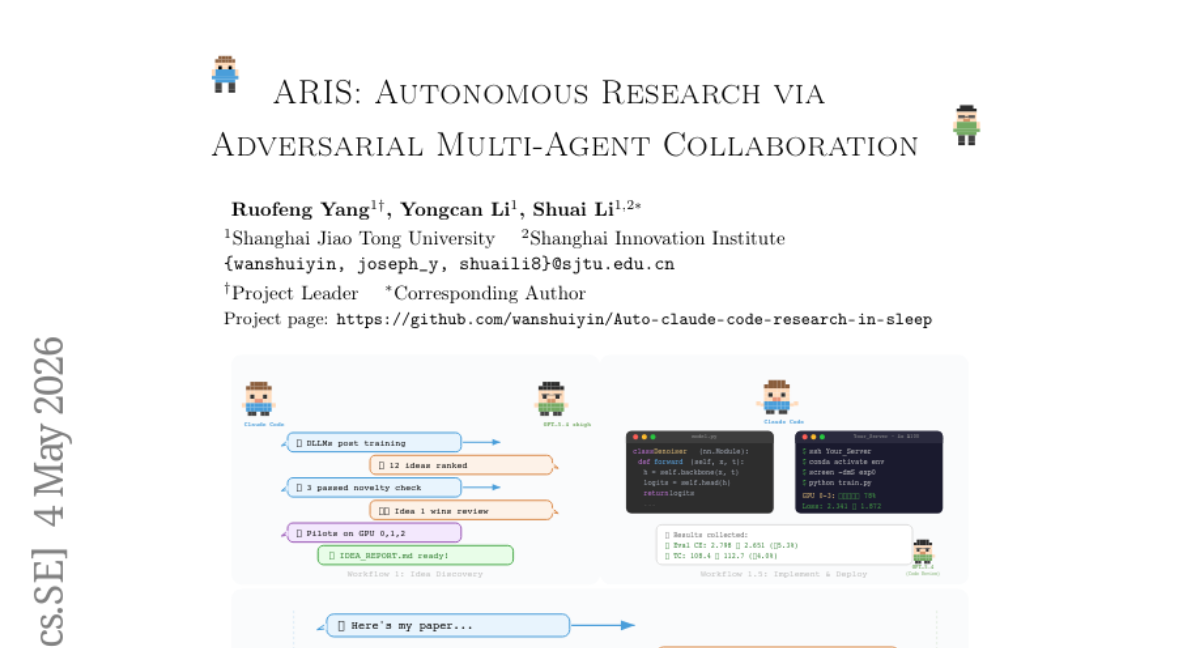
ARIS: Autonomous Research via Adversarial Multi-Agent Collaboration

ARIS is an open-source research harness that uses cross-model adversarial collaboration to ensure reliable long-term research outcomes through coordinated execution, orchestration, and assurance layers.

Submitted by
andito

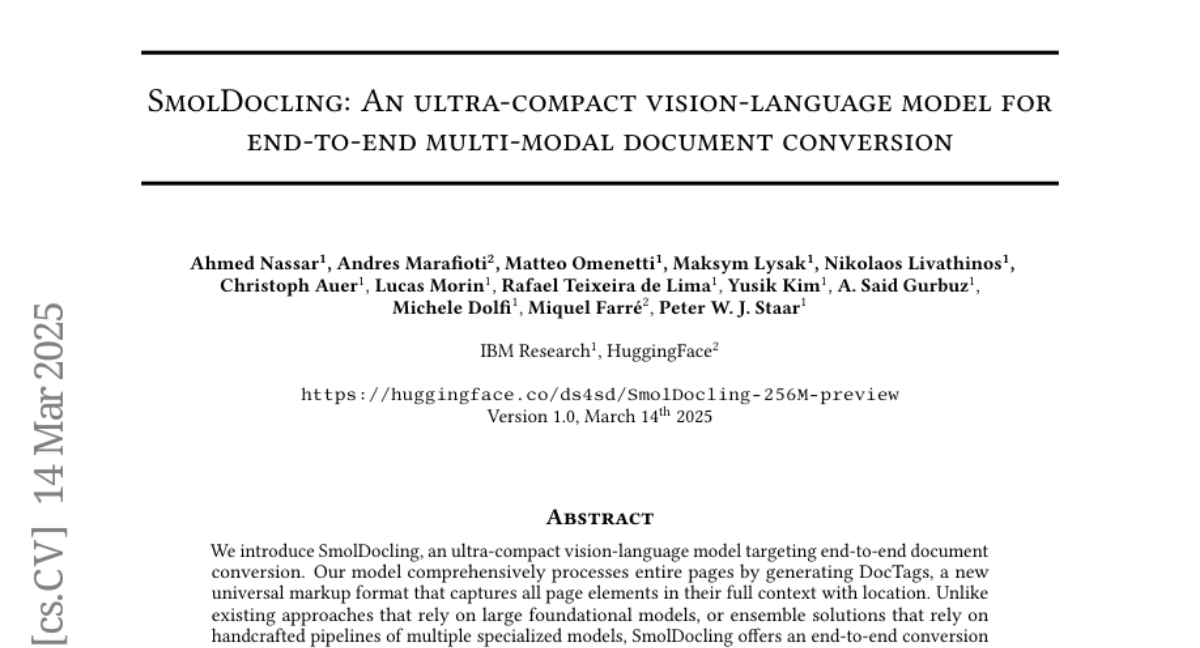
SmolDocling: An ultra-compact vision-language model for end-to-end multi-modal document conversion

SmolDocling is a compact vision-language model that performs end-to-end document conversion with robust performance across various document types using 256M parameters and a new markup format.

ibm-granite IBM Granite · Mar 14, 2025
Submitted by
Yuyang-z

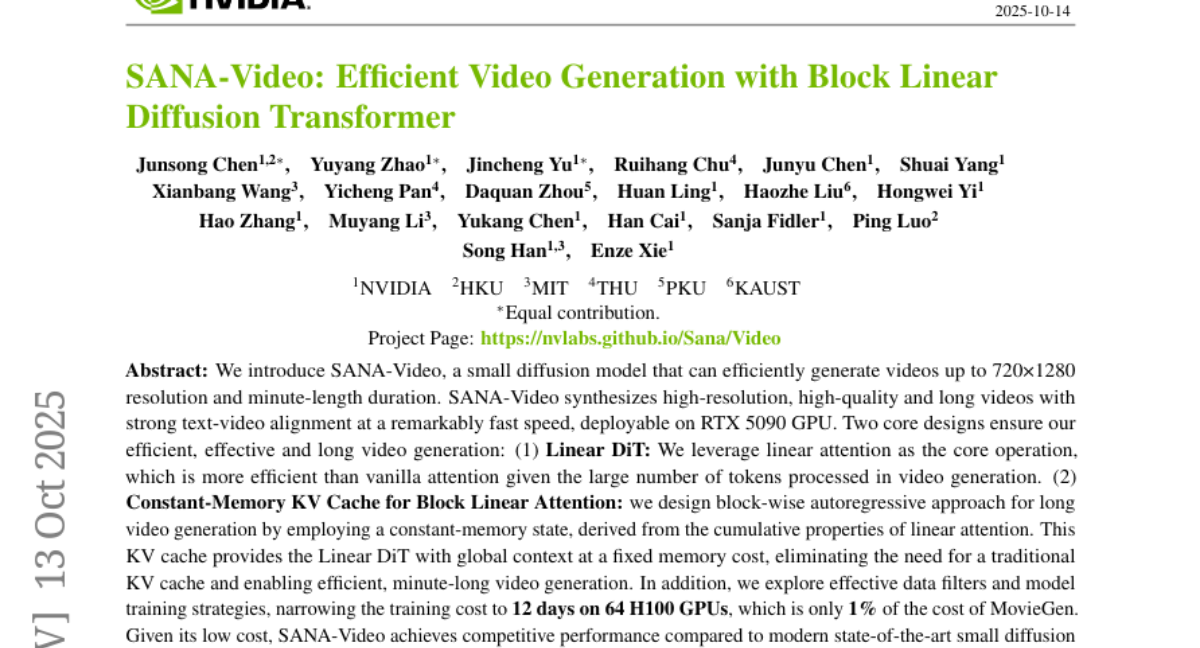
SANA-Video: Efficient Video Generation with Block Linear Diffusion Transformer

SANA-Video, a small diffusion model, efficiently generates high-resolution, high-quality videos with strong text-video alignment using linear attention and a constant-memory KV cache, achieving competitive performance at a lower cost and faster speed.

nvidia NVIDIA · Sep 29, 2025
Submitted by
Abyssaledge

MobileGym: A Verifiable and Highly Parallel Simulation Platform for Mobile GUI Agent Research

MobileGym presents a browser-based mobile environment enabling deterministic evaluation and scalable reinforcement learning through JSON-based state management and parallel execution.

  • 11 authors
· May 25, 2026
Submitted by
taesiri

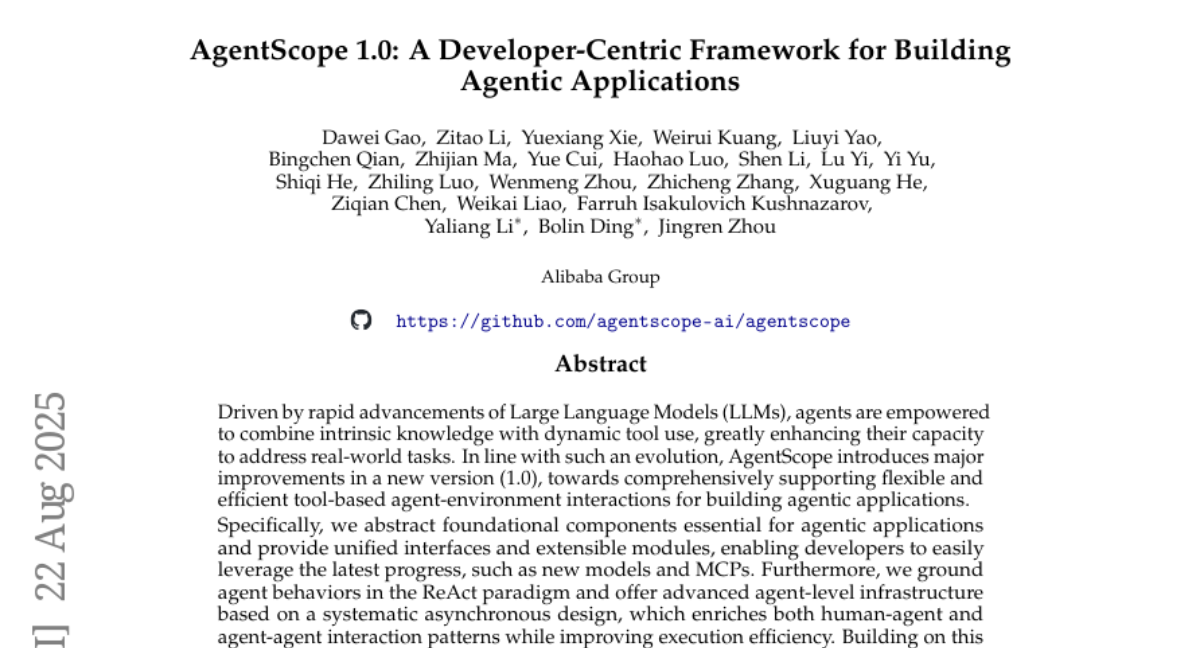
AgentScope 1.0: A Developer-Centric Framework for Building Agentic Applications

AgentScope enhances agentic applications by providing flexible tool-based interactions, unified interfaces, and advanced infrastructure based on the ReAct paradigm, supporting efficient and safe development and deployment.

  • 23 authors
· Aug 22, 2025
Submitted by
akhaliq

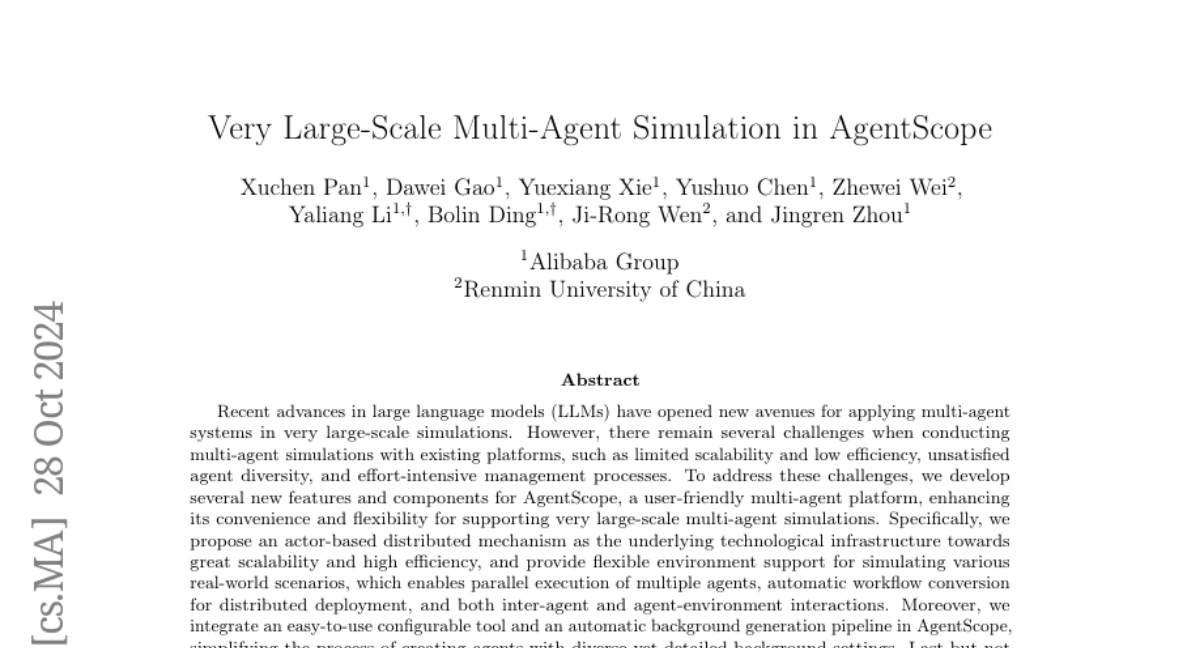
Very Large-Scale Multi-Agent Simulation in AgentScope

Enhancements to the AgentScope platform improve scalability, efficiency, and ease of use for large-scale multi-agent simulations through distributed mechanisms, flexible environments, and user-friendly tools.

  • 8 authors
· Jul 25, 2024

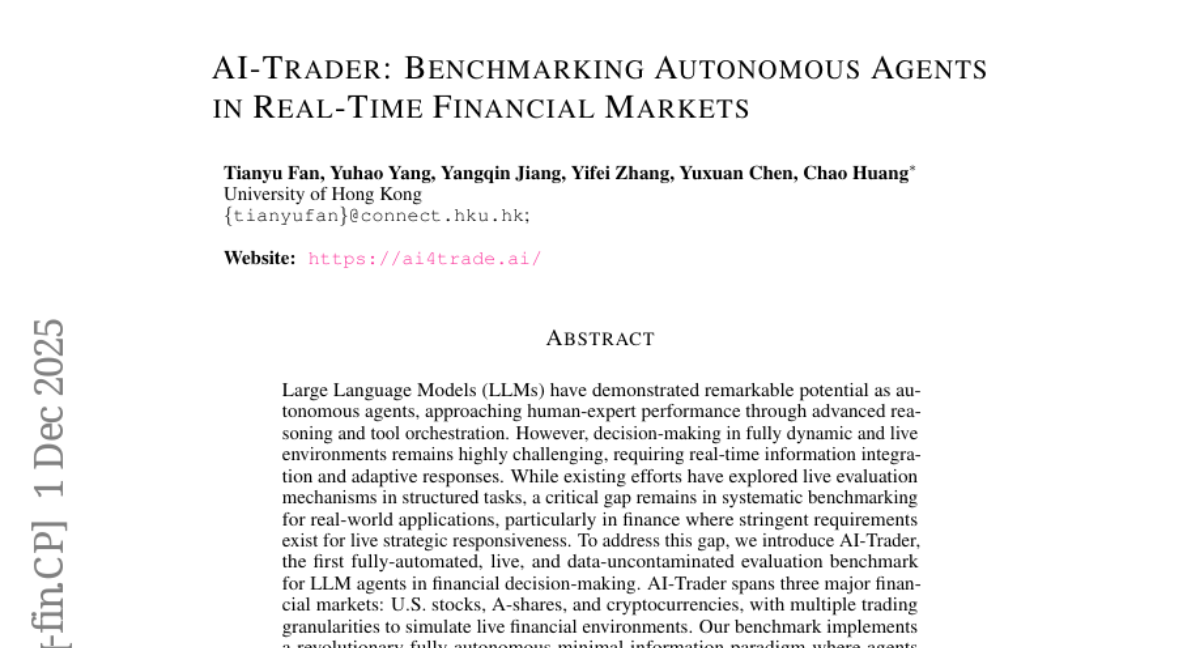
AI-Trader: Benchmarking Autonomous Agents in Real-Time Financial Markets

AI-Trader presents the first fully automated live benchmark for evaluating large language models in financial decision-making across multiple markets with autonomous information processing.

  • 6 authors
· Dec 1, 2025
Submitted by
VCLab-PolyU

GGT-100K: Generative Ground Truth for Generalizable Real-World Image Restoration

Generative multimodal foundation models are used to create high-quality training data for image restoration, improving model generalization across diverse real-world scenarios.

VCLab-HKPU VCLab · May 29, 2026
Submitted by
Ningyu

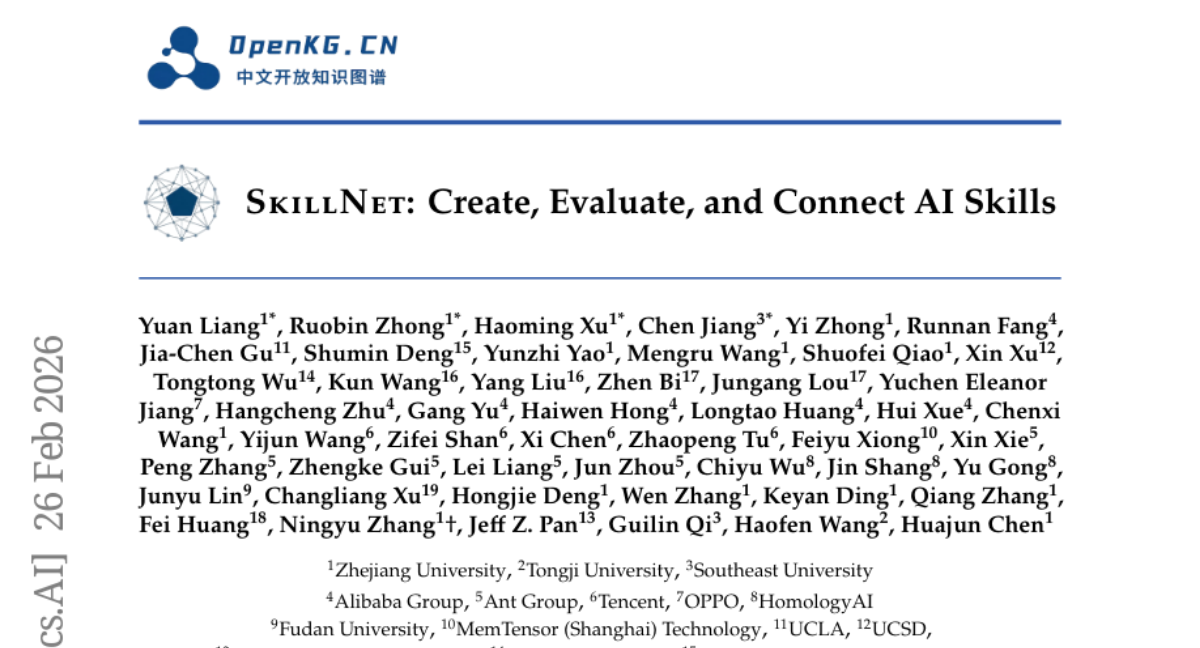
SkillNet: Create, Evaluate, and Connect AI Skills

SkillNet introduces an open infrastructure for systematically accumulating and transferring AI skills through a unified ontology, significantly improving agent performance across multiple domains.

ZhejiangUniversity Zhejiang University · Feb 26, 2026

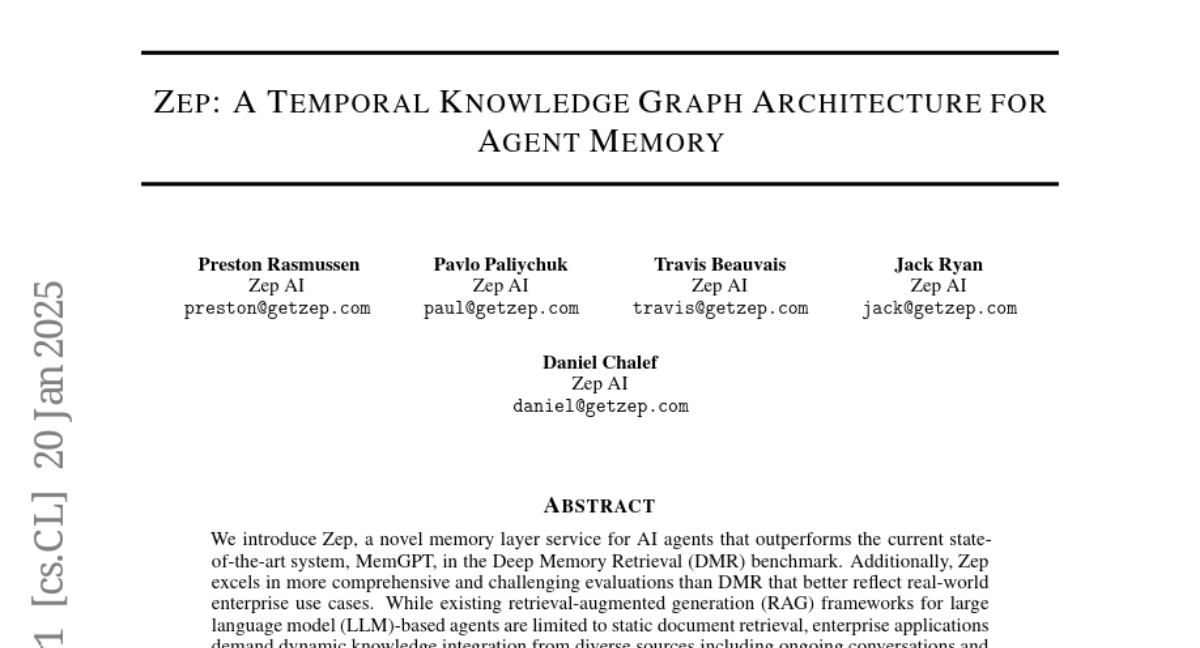
Zep: A Temporal Knowledge Graph Architecture for Agent Memory

Zep, a memory layer service, outperforms MemGPT in the DMR benchmark and LongMemEval by excelling in dynamic knowledge integration and temporal reasoning, critical for enterprise use cases.

  • 5 authors
· Jan 20, 2025
Submitted by
taesiri

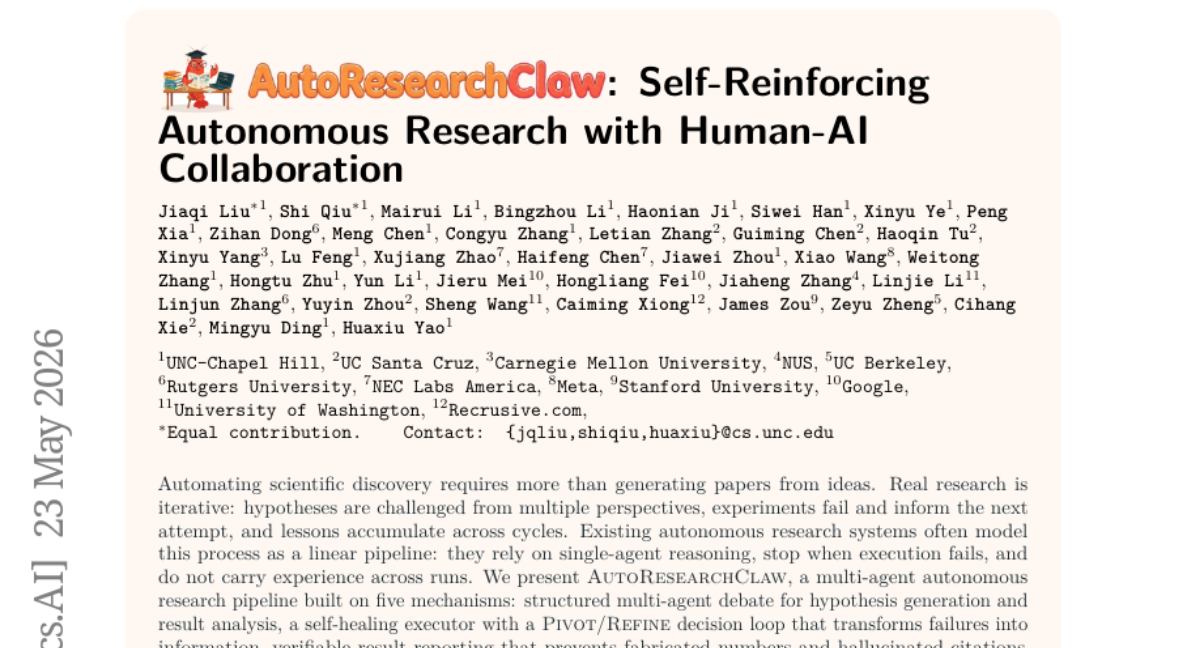
AutoResearchClaw: Self-Reinforcing Autonomous Research with Human-AI Collaboration

AutoResearchClaw is a multi-agent autonomous research system that improves scientific discovery through structured debate, self-healing execution, verifiable reporting, human collaboration, and evolutionary learning, outperforming previous systems on a benchmark while maintaining human oversight.

  • 35 authors
· May 19, 2026
Submitted by
filicos

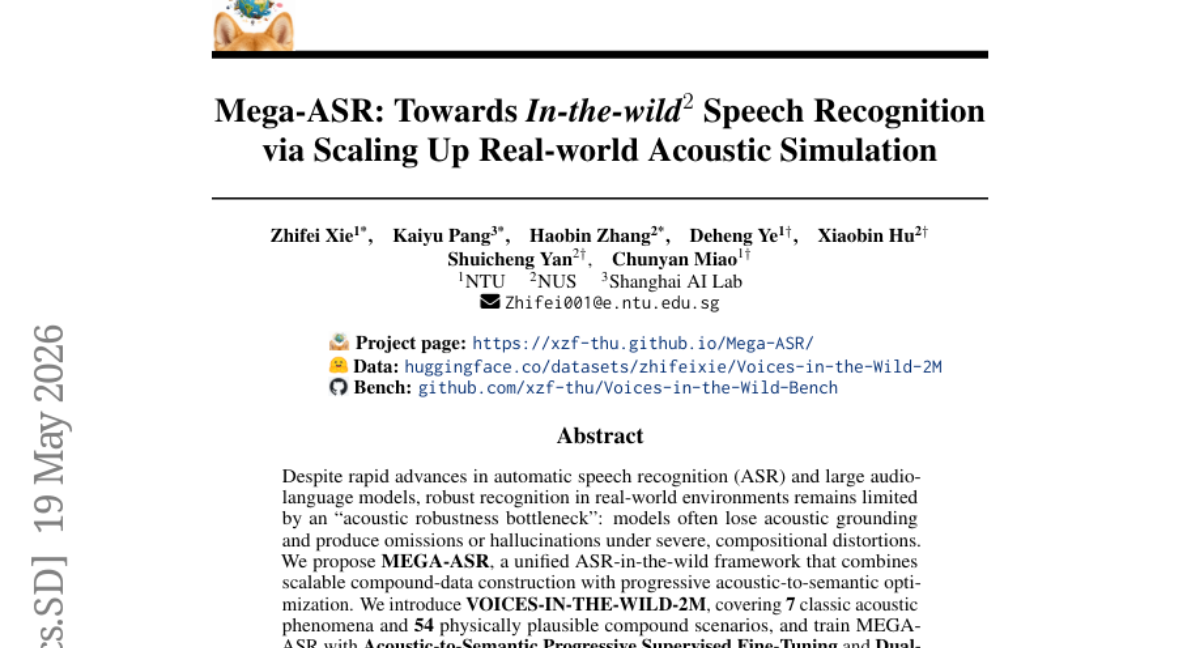
Mega-ASR: Towards In-the-wild^2 Speech Recognition via Scaling up Real-world Acoustic Simulation

Mega-ASR framework improves robustness in real-world speech recognition through compound-data construction and progressive acoustic-to-semantic optimization techniques.

Submitted by
lhmd

TriSplat: Simulation-Ready Feed-Forward 3D Scene Reconstruction

TriSplat is a feed-forward 3D reconstruction network that uses oriented triangle primitives to directly generate simulation-ready meshes from single images, bypassing expensive post-processing steps.

zju Zhejiang University · May 25, 2026

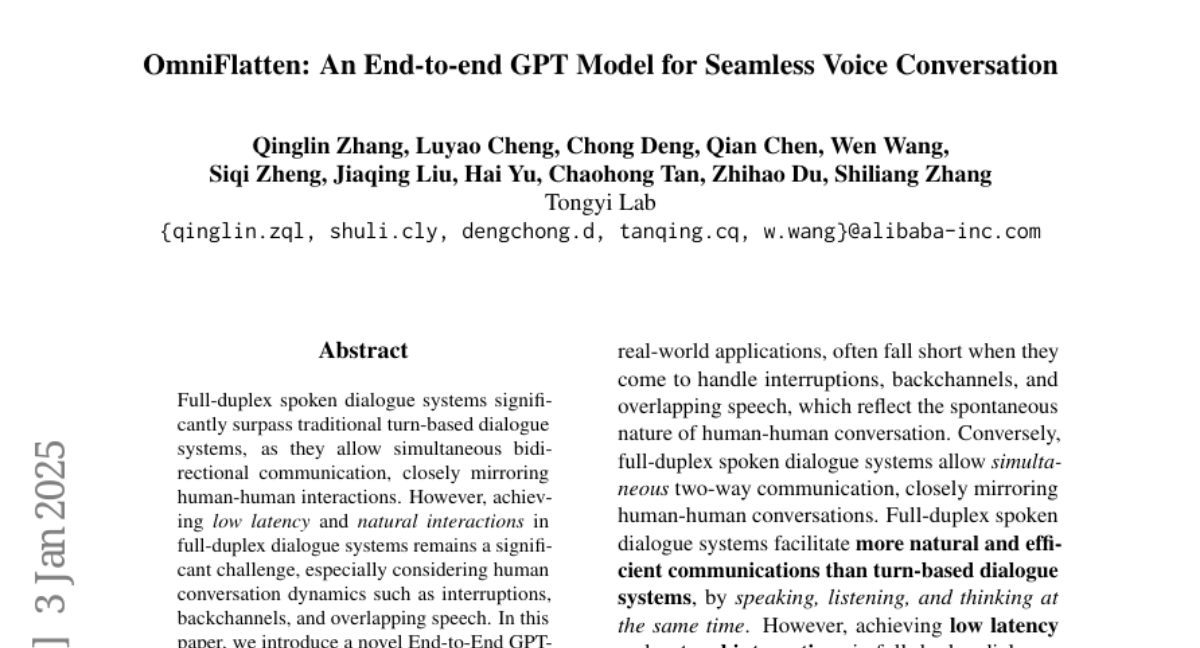
OmniFlatten: An End-to-end GPT Model for Seamless Voice Conversation

A novel GPT-based model, OmniFlatten, enables real-time natural full-duplex spoken dialogue through a multi-stage post-training technique that integrates speech and text without altering the original model's architecture.

  • 9 authors
· Oct 23, 2024
Submitted by
liangjiaqing

GenericAgent: A Token-Efficient Self-Evolving LLM Agent via Contextual Information Density Maximization (V1.0)

GenericAgent is a self-evolving large language model agent system that maximizes context information density through hierarchical memory, reusable SOPs, and efficient compression to overcome long-horizon limitations.

Fudan-University Fudan University · Apr 18, 2026

LightRAG: Simple and Fast Retrieval-Augmented Generation

LightRAG improves Retrieval-Augmented Generation by integrating graph structures for enhanced contextual awareness and efficient information retrieval, achieving better accuracy and response times.

  • 5 authors
· Oct 8, 2024

PDFMathTranslate: Scientific Document Translation Preserving Layouts

PDFMathTranslate enables layout-preserving scientific document translation using large language models and precise layout detection, offering improved precision, flexibility, and efficiency.

  • 4 authors
· Jul 2, 2025
Submitted by
xcjthu

MiniCPM4: Ultra-Efficient LLMs on End Devices

MiniCPM4, a highly efficient large language model for end-side devices, achieves superior performance using innovations in sparse attention, pre-training datasets, training algorithms, and inference systems.

openbmb OpenBMB · Jun 9, 2025

A decoder-only foundation model for time-series forecasting

A large language model adapted for time-series forecasting achieves near-optimal zero-shot performance on diverse datasets across different time scales and granularities.

  • 4 authors
· Oct 14, 2023
Submitted by
SereinH

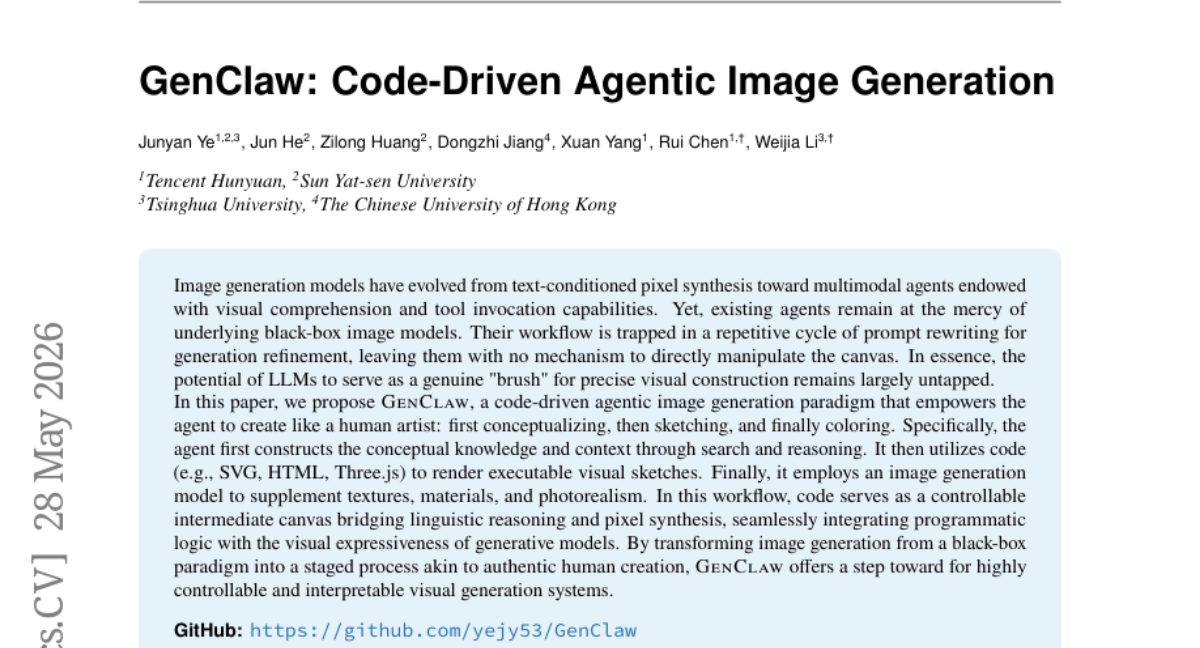
GenClaw: Code-Driven Agentic Image Generation

GenClaw presents a code-driven agentic image generation framework that enables precise visual construction through conceptualization, sketching, and coloring stages, integrating programmatic logic with generative models.

Tencent-Hunyuan Tencent Hunyuan · May 28, 2026
Submitted by
zbhpku

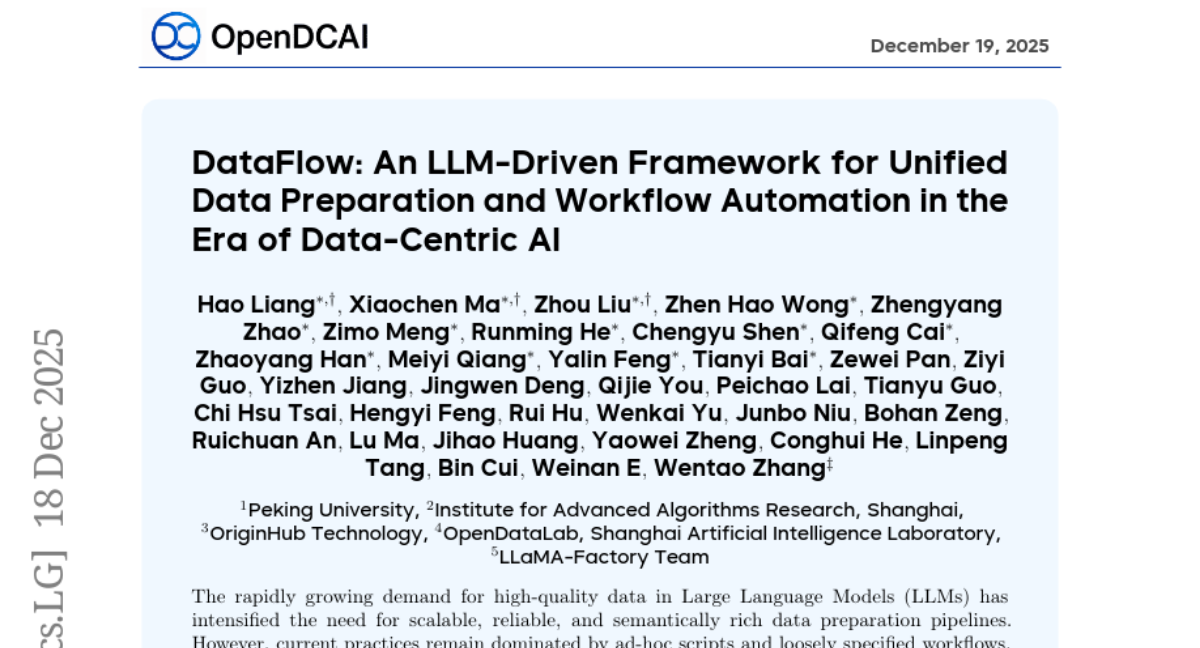
DataFlow: An LLM-Driven Framework for Unified Data Preparation and Workflow Automation in the Era of Data-Centric AI

DataFlow is an LLM-driven data preparation framework that enhances data quality and reproducibility for various tasks, improving LLM performance with automatically generated pipelines.

PekingUniversity Peking University · Dec 18, 2025
Submitted by
callanwu

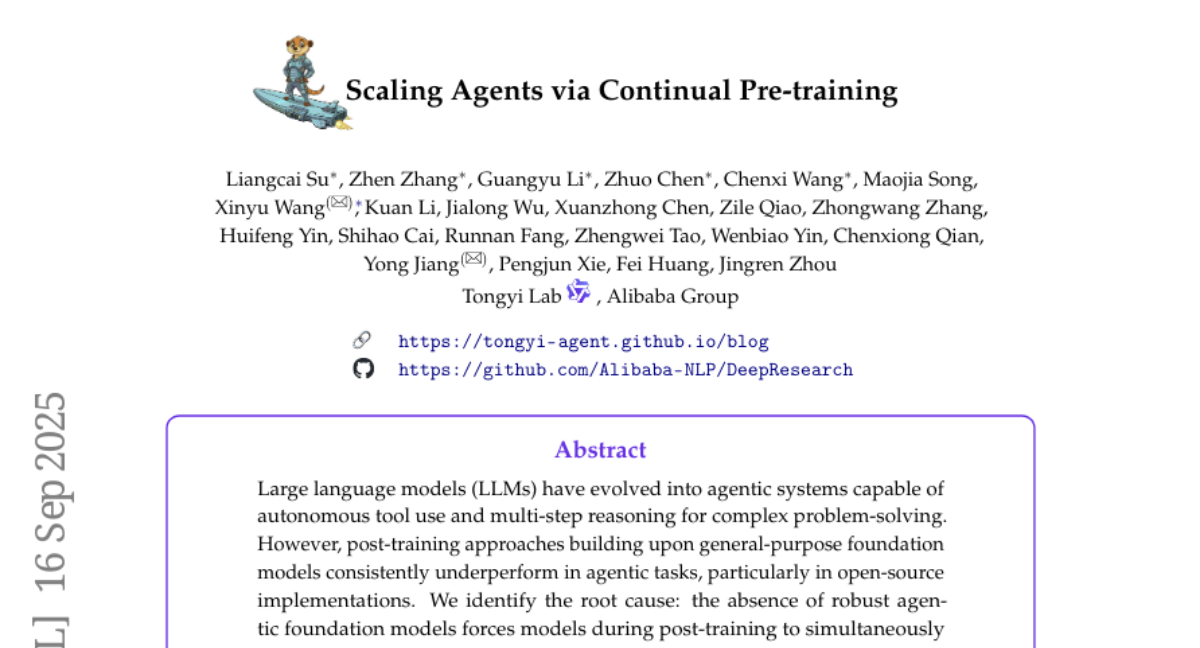
Scaling Agents via Continual Pre-training

AgentFounder, a deep research agent model incorporating Agentic Continual Pre-training, achieves state-of-the-art performance in agentic tasks while maintaining strong tool-use ability.

  • 22 authors
· Sep 16, 2025
Submitted by
callanwu

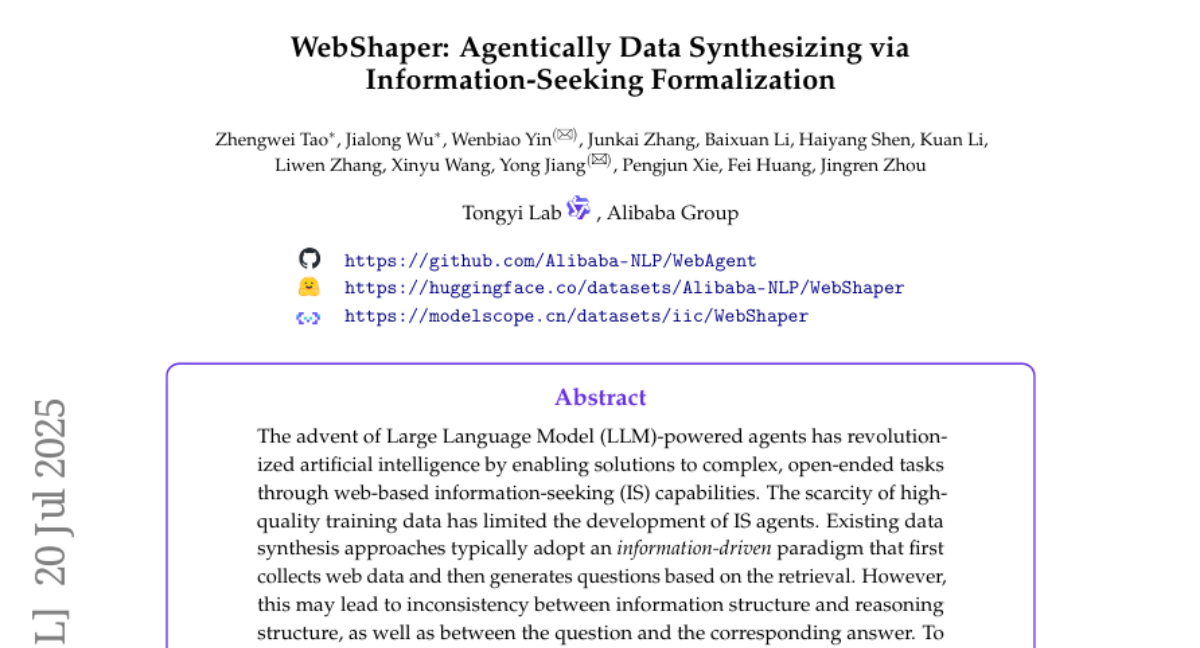
WebShaper: Agentically Data Synthesizing via Information-Seeking Formalization

WebShaper, a formalization-driven framework, synthesizes information-seeking datasets using set theory and Knowledge Projections to enhance reasoning structure and achieve top performance in open-sourced benchmarks.

Alibaba-NLP Alibaba-NLP · Jul 20, 2025
Submitted by
Rbin

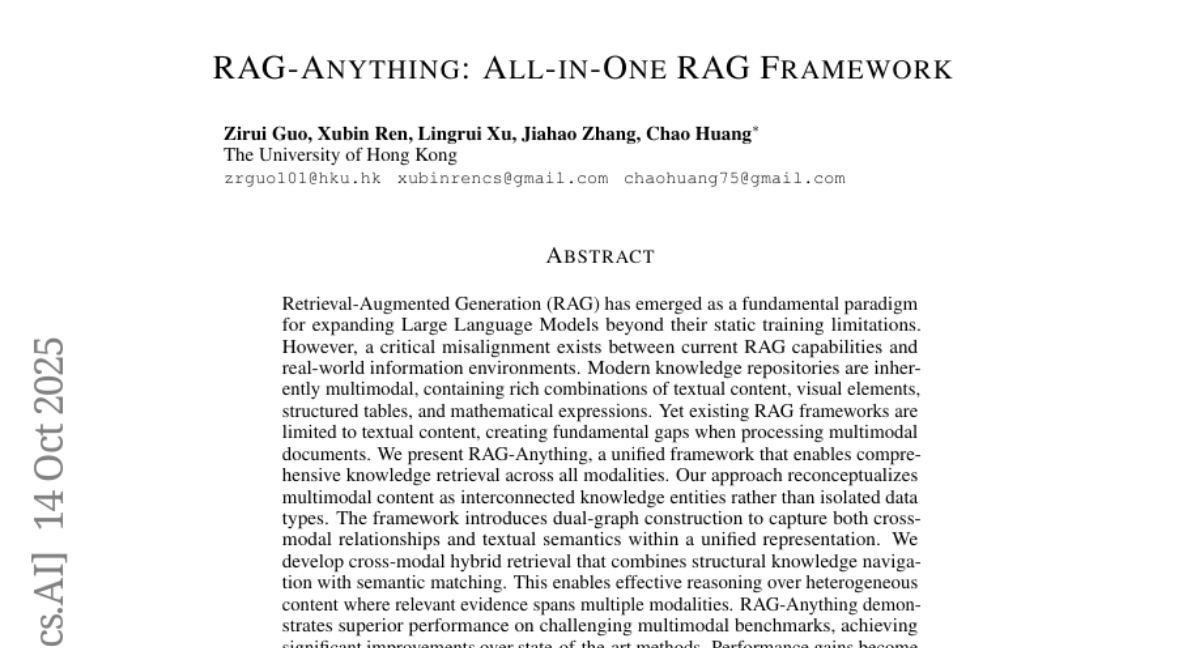
RAG-Anything: All-in-One RAG Framework

RAG-Anything is a unified framework that enhances multimodal knowledge retrieval by integrating cross-modal relationships and semantic matching, outperforming existing methods on complex benchmarks.

Submitted by
imone

HRM-Text: Efficient Pretraining Beyond Scaling

A Hierarchical Recurrent Model architecture with specialized training on instruction-response pairs achieves competitive language modeling performance with significantly reduced computational requirements compared to traditional Transformer-based approaches.

sapientinc Sapient AI · May 20, 2026
Submitted by
richardxp888

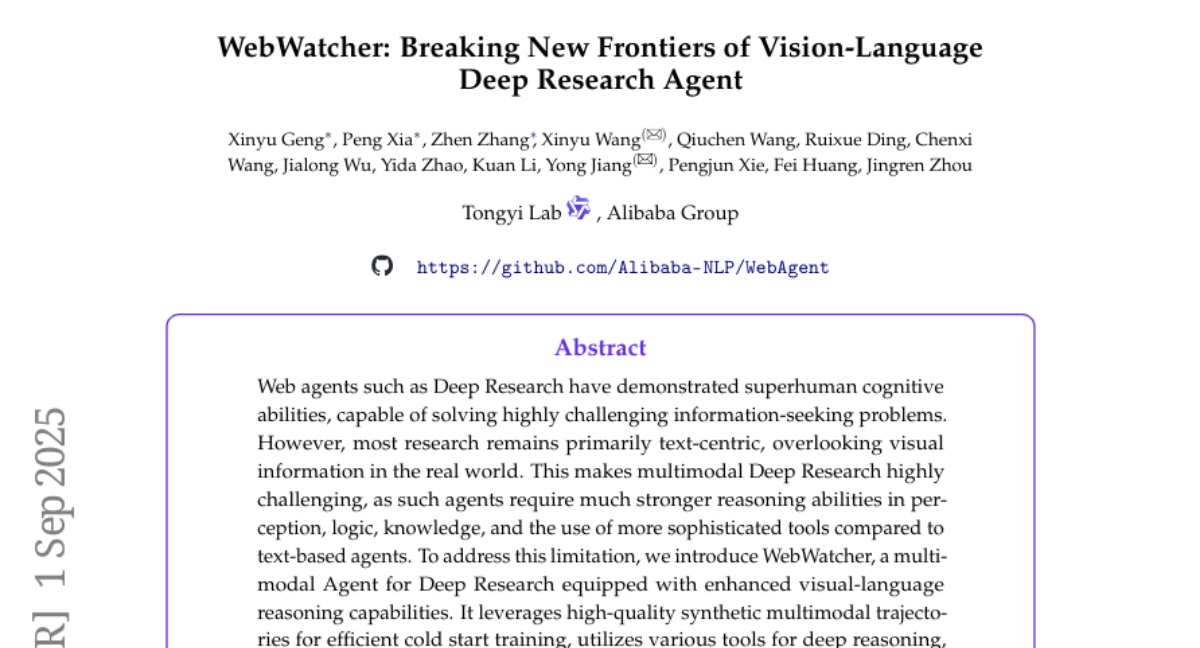
WebWatcher: Breaking New Frontier of Vision-Language Deep Research Agent

WebWatcher, a multimodal agent with enhanced visual-language reasoning, outperforms existing agents in complex visual and textual information retrieval tasks using synthetic trajectories and reinforcement learning.

Alibaba-NLP Alibaba-NLP · Aug 7, 2025
Submitted by
CoreloneH

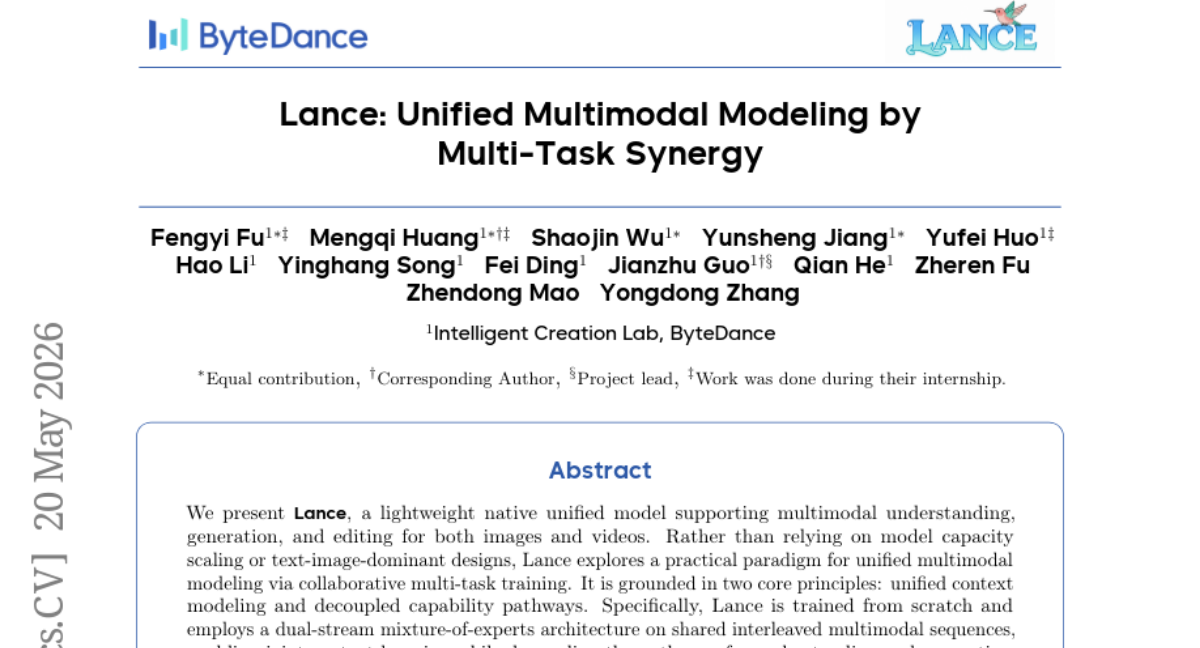
Lance: Unified Multimodal Modeling by Multi-Task Synergy

Lance is a unified multimodal model that combines understanding, generation, and editing capabilities for images and videos through collaborative multi-task training and a dual-stream architecture.

bytedance-research bytedance-research · May 18, 2026
Submitted by
NeoZ123

LongTraceRL: Learning Long-Context Reasoning from Search Agent Trajectories with Rubric Rewards

LongTraceRL addresses long-context reasoning challenges in large language models through tiered distractor construction and rubric reward design for improved reasoning quality.

Submitted by
Yirany

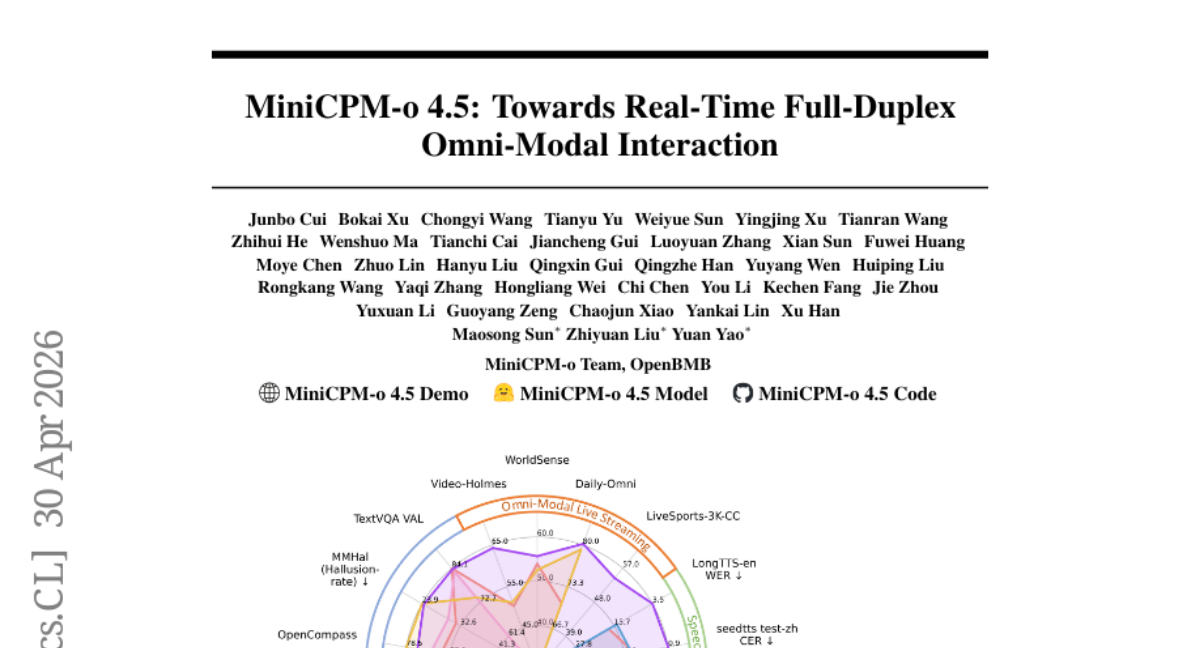
MiniCPM-o 4.5: Towards Real-Time Full-Duplex Omni-Modal Interaction

MiniCPM-o 4.5 enables real-time full-duplex multimodal interaction through Omni-Flow, a unified streaming framework that aligns inputs and outputs temporally for simultaneous perception and response.

openbmb OpenBMB · Apr 30, 2026
Submitted by
taesiri

MiniCPM-V 4.5: Cooking Efficient MLLMs via Architecture, Data, and Training Recipe

MiniCPM-V 4.5, a 8B parameter multimodal large language model, achieves high performance and efficiency through a unified 3D-Resampler architecture, a unified learning paradigm, and a hybrid reinforcement learning strategy.

  • 34 authors
· Sep 16, 2025
Submitted by
AaronHuangWei

LongLive-2.0: An NVFP4 Parallel Infrastructure for Long Video Generation

LongLive-2.0 presents an NVFP4-based parallel infrastructure for long video generation that addresses training and inference bottlenecks through sequence-parallel autoregressive training and diffusion model tuning.

nvidia NVIDIA · May 18, 2026
Submitted by
Zhongzhu

OSCAR: Offline Spectral Covariance-Aware Rotation for 2-bit KV Cache Quantization

OSCAR is an ultra-low-bit KV cache quantization method that aligns quantization with attention-aware covariance structures, achieving high accuracy and efficiency for long-context LLM serving.

togethercomputer Together · May 18, 2026
Submitted by
hao-li

Agent READMEs: An Empirical Study of Context Files for Agentic Coding

Agentic coding tools receive goals written in natural language as input, break them down into specific tasks, and write or execute the actual code with minimal human intervention. Central to this process are agent context files ("READMEs for agents") that provide persistent, project-level instructions. In this paper, we conduct the first large-scale empirical study of 2,303 agent context files from 1,925 repositories to characterize their structure, maintenance, and content. We find that these files are not static documentation but complex, difficult-to-read artifacts that evolve like configuration code, maintained through frequent, small additions. Our content analysis of 16 instruction types shows that developers prioritize functional context, such as build and run commands (62.3%), implementation details (69.9%), and architecture (67.7%). We also identify a significant gap: non-functional requirements like security (14.5%) and performance (14.5%) are rarely specified. These findings indicate that while developers use context files to make agents functional, they provide few guardrails to ensure that agent-written code is secure or performant, highlighting the need for improved tooling and practices.

  • 11 authors
· Nov 17, 2025